
Open source · MIT License · arXiv 2604.05014 开源 · MIT 协议 · arXiv 2604.05014

StarVLA A Lego-like Codebase for VLA Model Developing 乐高式的视觉-语言-动作模型开发代码库

Swap backbones, action heads, training recipes and benchmarks independently. One shared infrastructure to build, train and evaluate VLA policies — in simulation and on real robots. 骨干网络、动作头、训练策略与评测基准各自独立、随意替换。用同一套基础设施构建、训练并评测 VLA 策略——覆盖仿真与真机。

git clone https://github.com/starVLA/starVLA.git && cd starVLA && pip install -e .

Compose your VLA 组合你的 VLA

One brick per layer — all combos share one trainer and policy server. 每层选一块积木。所有组合共用同一套训练器、数据加载与策略服务。

Backbone 骨干网络
Action head 动作头
Training recipe 训练策略
Benchmark 评测基准
configs/my_vla.yaml
 

Illustrative config — see the docs for supported combos and scripts. 示意性配置,实际支持的组合与入口脚本请以文档为准。

3.9K GitHub stars GitHub Stars
27 Policy implementations 策略实现
13 Simulation benchmarks 仿真基准
519 Forks Forks
10 Robot embodiments 机器人本体
41+ Checkpoint repos 模型检查点仓库
Architecture 架构

Four plug-and-play layers 四层即插即用

Each functional component follows a top-down separation with high cohesion and low coupling. Swap a brick, keep the rest — a new framework variant is usually just a different backbone or action head. 每个功能组件都遵循自顶向下、高内聚低耦合的划分。换一块积木、复用其余部分——新的框架变体往往只是换个骨干或动作头。

01

Backbone network 骨干网络

VLM backbones (Qwen3-VL, QwenVL-MoE, Qwen3.5, InternVL, Florence-2) and world-model backbones (Cosmos-Predict2, Wan2.2) behind one interface. VLM 骨干(Qwen3-VL、QwenVL-MoE、Qwen3.5、InternVL、Florence-2)与世界模型骨干(Cosmos-Predict2、Wan2.2)共用同一接口。
Qwen3-VLQwenVL-MoEQwen3.5InternVLFlorence-2CosmosWan2.2
02

Action head 动作头

Autoregressive FAST tokens, parallel OFT regression, flow-matching π experts and GR00T-style dual-system inference. 自回归 FAST token、并行 OFT 回归、流匹配 π 专家以及 GR00T 式双系统推理。

FASTOFTπ / FlowGR00T
03

Training strategy 训练策略

SFT, multimodal co-training, cross-embodiment training and RL post-training — paradigm-agnostic, applied uniformly to every framework. SFT、多模态联合训练、跨本体训练与 RL 后训练——与范式无关,统一适用于所有框架。

SFTCo-trainingCross-embodimentRL
04

Benchmark evaluation 基准评测

A WebSocket policy server decouples model execution from simulator dependencies. The same interface drives simulation and real robots. WebSocket 策略服务将模型执行与仿真器依赖解耦,同一接口同时驱动仿真与真机。

LIBEROSimplerEnvRoboTwinRoboCasaBEHAVIORReal robots
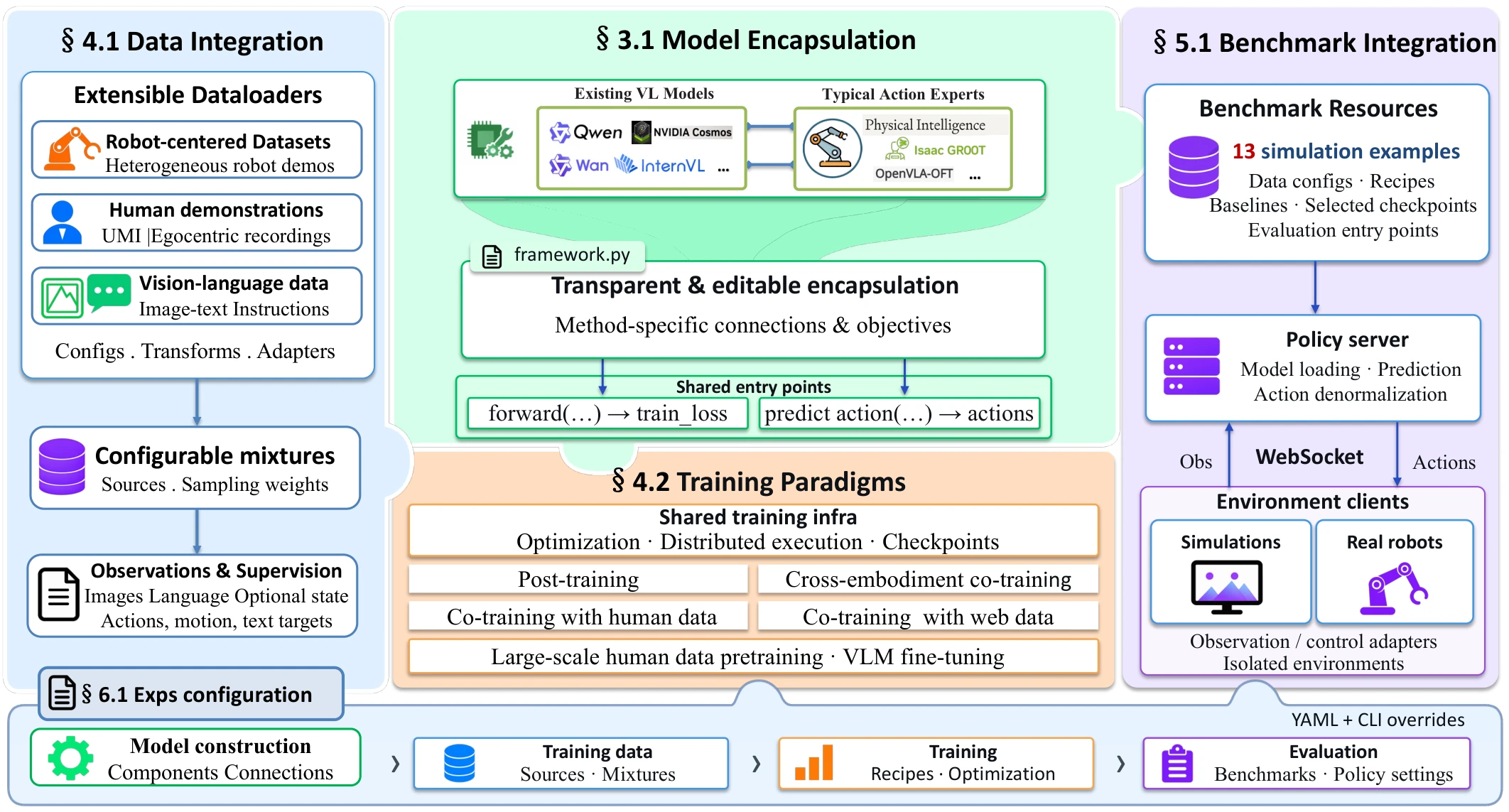
Overview of the StarVLA framework: data integration, model encapsulation, training paradigms and benchmark integration, tied together by one experiment configuration.
StarVLA organises VLA research as a composable stack. Each axis is decoupled, so a new variant typically reduces to swapping one layer while reusing the rest. StarVLA 将 VLA 研究组织为可组合的栈:各层相互解耦,新变体通常只需替换一层并复用其余部分。

Design principles 设计原则

  • Top-down separation 自顶向下划分 Model, data, trainer, config and evaluation live in independent modules you can debug on their own. 模型、数据、训练器、配置与评测位于相互独立的模块中,可单独调试。
  • Two shared entry points 两个共享入口 A framework only needs forward(...) → loss and predict_action(...) → actions; everything else is reused. 一个框架只需实现 forward(...) → loss 与 predict_action(...) → actions,其余全部复用。
  • Config-driven experiments 配置驱动实验 YAML settings with CLI overrides and saved snapshots, so every run is reproducible. YAML 配置 + CLI 覆盖 + 快照保存,每次实验都可复现。
  • Isolated environments 环境隔离 Model dependencies stay in the policy server; simulator dependencies stay in the client. 模型依赖留在策略服务端,仿真器依赖留在客户端。
VLM image 图像 text 文本 FAST tokens FAST token

StarVLA-FAST

The VLM writes the actions itself, as discrete FAST tokens, one at a time. VLM 自己逐个写出离散的 FAST 动作 token。

VLM/WM image 图像 text 文本 queries 动作 token actions 动作 MLP

StarVLA-OFT

Action query tokens go at the end of the prompt; an MLP regresses the whole chunk from their last-layer states at once. 指令后接上动作 token,MLP 从它们最后一层的隐状态一次回归出整段动作。

VLM/WM image 图像 text 文本 actions 动作 DiT noise 噪声

StarVLA-GR00T

A flow-matching DiT denoises the chunk; every DiT layer cross-attends to the VLM’s last layer. 流匹配 DiT 从噪声去噪出动作,每一层都交叉注意 VLM 的最后一层。

VLM/WM image 图像 text 文本 actions 动作 DiT noise 噪声

StarVLA-π

The same kind of DiT, wired layer by layer: DiT layer i attends to VLM layer i. 同样是流匹配 DiT,但逐层对接:DiT 的第 i 层看 VLM 的第 i 层。

Four reference frameworks share the same data interface and infrastructure — only the action head differs. 四个参考框架共享同一数据接口与基础设施——区别仅在动作头。 VLM/WM, shared VLM/WM,共享 action head, differs 动作头,各不相同
Benchmarks 基准

Simple recipes, strong baselines 简单配方,强力基线

Fully reproducible single-benchmark recipes with minimal data engineering already match or surpass prior methods. Numbers are from the official docs and repository, with sources linked. 极少数据工程、完全可复现的单基准配方已能匹敌或超越既有方法。数字来自官方文档与仓库,并附来源链接。

SimplerEnv

WidowX success · StarVLA-GR00T WidowX 成功率 · StarVLA-GR00T
71.4%
Source 来源

RoboCasa-GR1

Average success · StarVLA-OFT 平均成功率 · StarVLA-OFT
48.8%
Source 来源

RoboTwin 2.0

Average hard score · StarVLA-OFT Hard 平均分 · StarVLA-OFT
88.3
Source 来源

StarVLA vs. π₀.₅ across benchmarks StarVLA 与 π₀.₅ 的跨基准对比

Success rate (%). Specialist models are trained per benchmark; the Generalist is jointly trained across all benchmarks and is shown as a reference upper bound. For comparisons under similar compute, focus on Specialist. 成功率(%)。Specialist 逐基准训练;Generalist 在全部基准上联合训练,仅作为上限参考。同等算力下的对比请以 Specialist 为准。

StarVLA Specialist StarVLA 专家模型 StarVLA Generalist StarVLA 通用模型 π₀.₅
LIBERO
98.8%
97.8%
96.9%
LIBERO-Plus
77.8%
79.7%
–
SimplerEnv WidowX
64.6%
70.2%
46.9%
SimplerEnv Google VA
70.2%
73.8%
68.4%
SimplerEnv Google VM
76.0%
79.3%
72.7%
RoboTwin Clean*
88.2%
88.7%
82.7%
RoboTwin Random*
88.3%
87.8%
76.8%
RoboCasa-GR1
53.8%
57.3%
37.0%
RoboChallenge
30.0%
–
17.7%

* RoboTwin 2.0 hard setting. * RoboTwin 2.0 困难设置。

Integrated benchmarks 已集成基准

Every benchmark ships with a training recipe, a policy-server entry point and an evaluation script. Click one to open its example. 每个基准都附带训练配方、策略服务入口与评测脚本,点击即可打开对应示例。

Research 研究

Research built on StarVLA 基于 StarVLA 的研究

StarVLA is the official implementation of the following work from our team, and the substrate for a growing set of community projects. StarVLA 是以下团队工作的官方实现,也是越来越多社区项目的基础。

Study 探究 ECCV 2026 · arXiv 2604.11757

StarVLA-α: Reducing Complexity in Vision-Language-Action Systems

Systematically strips VLA systems down to what actually matters, with controlled comparisons across action heads, backbones and recipes. 系统性地剖析 VLA 系统中真正重要的部分,对动作头、骨干与训练策略进行受控对比。

Pre-training 预训练 arXiv 2608.27550 · 2026

VLAct: Beyond Data Scaling — Representation-Centric Continued Pre-training for VLA Models

Representation-centric continued pre-training that yields reusable VLA backbones. Drop-in replacement for any Qwen3-VL-4B StarVLA recipe. 以表征为中心的继续预训练,产出可复用的 VLA 骨干;可直接替换任何 Qwen3-VL-4B StarVLA 配方。

61 community research projects build on StarVLA 个社区研究项目基于 StarVLA

Since Oct 2025, and growing. 自 2025 年 10 月起,仍在增加。

14 Mar 2026 2026.03
39 Jun 2026 2026.06
61 Sep 2026 2026.09
  • NoTVLA
  • LaRA-VLA
  • TempoFit
  • AssemLM
  • DiscreteRTC
  • IntentVLA
  • FineVLA
  • LaWAM
  • Anchor-Align
  • W²-VLA
  • Latent Action Study
  • LayerRoute
  • CoRe-WAM
  • PhysBrain
  • VLA-TMEE
  • DiT4DiT
  • JoyAI-RA 0.1
  • Keystone
  • PhysBrain 1.0
  • OneVLA
  • EventVLA
  • FoMoVLA
  • SLIM
  • GlanceWAM
  • EffVLA
  • CLAP
  • VLA-JEPA
  • VP-VLA
  • CorridorVLA
  • LoopVLA
  • Afford-VLA
  • PHASER
  • Action Prior Learning
  • JoyNexus
  • StellaVLA
  • VLAct
  • SCULPT-VLA
  • TwinBrainVLA
  • ABot-M0
  • LaMP
  • ResVLA
  • Multi-view VLA
  • Lngram
  • SPARC
  • LA4VLA
  • HiFi-UMI
  • DeepInsight II
  • Temporal Forcing
  • ActiveArena
  • LangForce
  • LDA-1B
  • DriveDreamer-Policy
  • LoHo-Manip
  • FrameSkip
  • Rethink VLA Init.
  • Beyond English
  • WALA
  • TurboVLA
  • FabriMAE
  • TacPAC
  • THAW-VLA
Quick start 快速开始

From zero to a running policy 从零到跑起来

Pick a task, copy the commands, and you're running. Evaluation splits the policy server and the simulator into separate terminals, so their dependencies never collide. 选择目标并复制命令。评测始终使用两个终端:策略服务将模型依赖与仿真器隔离。

Model zoo 模型库

Model zoo 模型库

Published backbones and checkpoints to reproduce or extend StarVLA experiments. 已发布的骨干与检查点,可直接复现或扩展 StarVLA 实验。

Community 社区

Join the community 加入社区

StarVLA is maintained by an open community of researchers and engineers. Issues, PRs and new benchmark integrations are always welcome. StarVLA 由开放的研究者与工程师社区维护,欢迎提交 Issue、PR 与新的基准集成。

Citation 引用

Citation 引用

If StarVLA helps your research, please cite the technical report and related work. 如果 StarVLA 对你的研究有帮助,请引用技术报告和相关工作。

starvla.bib
@article{community2026starvla,
  title={StarVLA: A Lego-like Codebase for Vision-Language-Action Model Developing},
  author={{StarVLA Community}},
  journal={arXiv preprint arXiv:2604.05014},
  year={2026},
  eprint={2604.05014},
  archivePrefix={arXiv},
  primaryClass={cs.RO}
}

@inproceedings{ye2026starvlaalpha,
  title={StarVLA-$\alpha$: Reducing Complexity in Vision-Language-Action Systems},
  author={Ye, Jinhui and Gao, Ning and Yang, Senqiao and Zheng, Jinliang and Wang, Zixuan and Chen, Yuxin and Chen, Pengguang and Chen, Yilun and Liu, Shu and Jia, Jiaya},
  booktitle={European Conference on Computer Vision (ECCV)},
  year={2026},
  eprint={2604.11757},
  archivePrefix={arXiv},
  primaryClass={cs.RO}
}

@article{yang2026vlact,
  title={Beyond Data Scaling: Representation-Centric Continued Pre-training for Vision-Language-Action Models},
  author={Yang, Senqiao and Wang, Chengyao and Chen, Yuxin and Wang, Zixuan and Tang, Longxiang and Gui, Haokun and Ye, Jinhui and Lu, Changsheng and Wu, Xiaoyang and Zhu, Mingkang and Chen, Pengguang and Liu, Shu and Tian, Zhuotao and Zhao, Hengshuang and Yu, Bei and Jia, Jiaya},
  journal={arXiv preprint arXiv:2608.27550},
  year={2026},
  eprint={2608.27550},
  archivePrefix={arXiv},
  primaryClass={cs.RO}
}